




Petr Slavíček (head)
e +420 22044 3687
b Petr.Slavicek@vscht.cz
Lucie Fialková (secretary)
e +420 22044 4269
b Lucie.Fialkova@vscht.cz
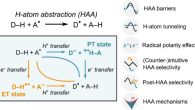
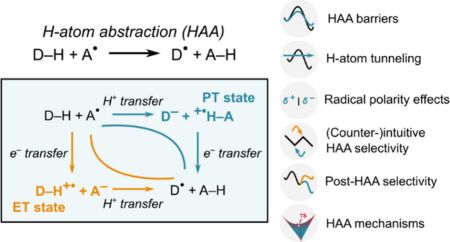
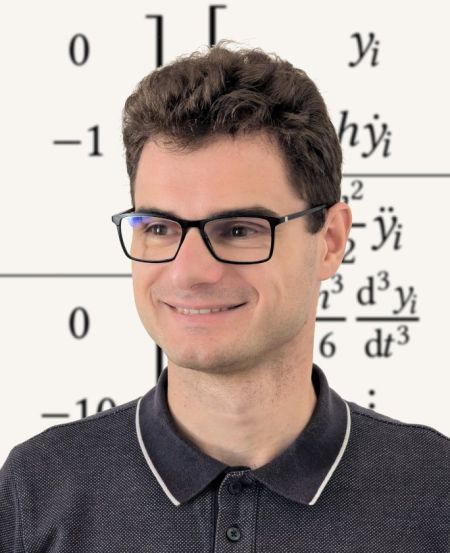
The journal Accounts of Chemical Research has published the review article Thermodynamic Principles Behind Mechanisms and Reactivities: Hydrogen Atom Abstraction and Related Radical Reactions, co-authored by Daniel Bím from the Department of Physical Chemistry.
The article addresses reactions involving hydrogen atom transfer: processes that underlie the function of many enzymes, participate in cellular respiration and photosynthesis, and are widely used in modern synthetic organic chemistry. Despite their prevalence, the rates and selectivities of these reactions are often difficult to predict.
The authors show that not only the overall thermodynamic driving force is decisive for reactivity, but also how transfers of electron and proton (i.e., the two particles that together constitute a hydrogen atom) are coupled during the reaction. This relationship is described using the concept of so-called off-diagonal thermodynamics, which enables quantitative prediction of reaction rates and selectivity and explains cases in which, for example, a stronger bond reacts preferentially over a weaker one.
Daniel Bím has been involved in this topic since his PhD studies, when he began collaborating with Martin Srnec (J. Heyrovský Institute of Physical Chemistry) on the development of the fundamental principles of this concept. Martin Srnec then developed the theory further, incorporated it into the broader framework of coupled proton and electron transfers, and applied it to additional types of reactions. The present publication thus provides a comprehensive summary of several years of theoretical development as well as a continuation of the long-standing and successful collaboration between the two authors.
Rudolf Kvasňovský, a third-year student of the bachelor's program Chemistry, won second place in the competition for the best poster at the Hünfeld 2025: Workshop on Computer Simulation and Theory of Macromolecules conference. Congratulations!
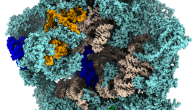
R. Kvasňovský is member of Michal Kolář's research group, where he focuses on simulations of the mitochondrial ribosome. Unlike universal ribosomes, which are found in the cytosol or on the endoplasmic reticulum of eukaryotic cells, the mitochondrial ribosome is highly specialized. In human cells, it synthesizes only 13 proteins, whereas universal ribosomes synthesize several tens of thousands of proteins. R. Kvasňovský's poster, titled Simulation Model of the Mitochondrial Ribosome, represents nearly a year of work.
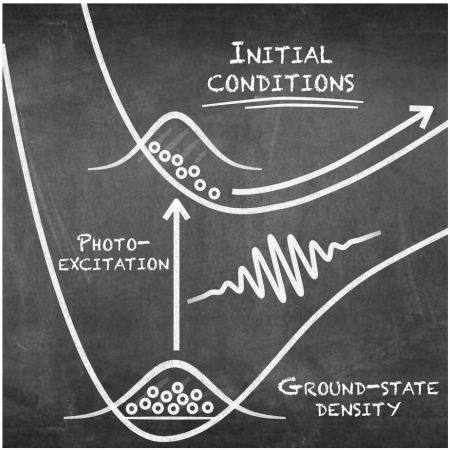
Petr Slavíček and Jiří Janoš together with Basile Curchod from Bristol University discuss the limits of trajectory-based approaches for photochemical simulations: https://pubs.acs.org/doi/10.1021/acs.accounts.4c00687
The funded project focuses on developing advanced nickel catalysts for efficient use in redox and photochemical reactions as an environmentally friendly alternative to methods that rely on precious and toxic metals.
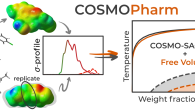
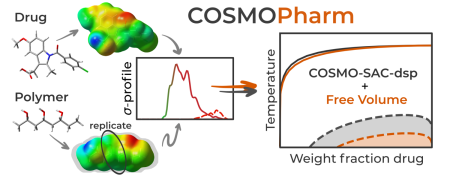
The Laboratory of Computational Thermodynamics, in collaboration with Technische Universität Berlin, presents in a new study published in Molecular Pharmaceutics the capabilities of the quantum mechanics-aided COSMO-SAC model to predict the compatibility of drugs and polymers. This is a key aspect in the design of drug formulations based on amorphous solid dispersions. The related computational tool COSMOPharm is freely available on GitHub. The study was supported by the Czech Science Foundation (project 22-07164S).
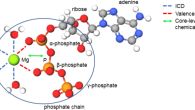
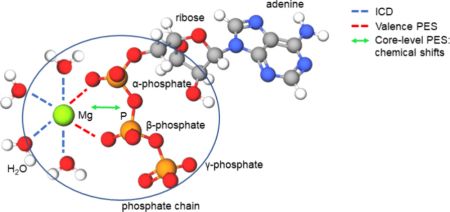
A new work “How Does Mg2+(aq) Interact with ATP(aq)? Biomolecular Structure through the Lens of Liquid-Jet Photoemission Spectroscopy” was published Journal of the Amercial Chemical Society. The research team PHOTOX from our department has provided the interpretation of the experimental results.